Silicone Molding
Custom silicone molding for prototype builds.
Silicone molding services for prototype and NPI builds — compression-molded Shore A 30–70 to ISO 3302-1 M2, tooling in 7–12 working days, inspection report with every shipment.

One-stop prototype & low-volume build · Inspection report with every part · Quote in 24 h
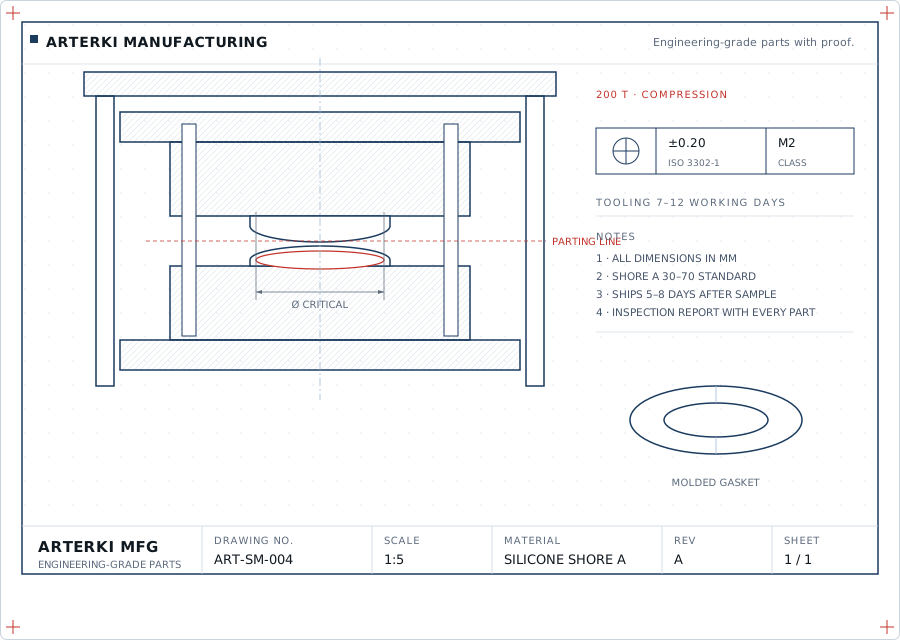
Your prototype build is nearly done: housings cut, brackets machined, covers printed. What is missing is the silicone — the gasket that makes the enclosure seal, the keypad that makes it usable in a user test, the damping pad that keeps the assembly from rattling on the shaker table. Arterki's silicone molding services cover those parts in-house on a 200 t compression press, with prototype tooling completed in 7–12 working days and molded parts shipped 5–8 working days after you approve the first article. Put the silicone on the same purchase order as your CNC-machined and 3D-printed components and receive one consolidated shipment with one inspection trail.
Arterki compression-molds silicone parts in Shore A 30/40/50/60/70 grades to ISO 3302-1 M2 class tolerances. Prototype tooling runs 7–12 working days on a 200 t press with a full in-house curing line. Parts ship 5–8 working days after sample approval, MOQ ≈50 pieces, cavity-dependent. Inspection report with every shipment.
Every part ships with an inspection report. For molded silicone that means: the critical dimensions called out on your drawing are measured against the ISO 3302-1 M2 class we quote to, and flash and visual quality are checked before packing. The report travels with the parts, not in a separate portal.
Silicone molding capability
These are the parameters we quote against. Anything not listed below is a conversation, not a capability claim — ask at quotation and we will confirm against the shop schedule before we commit.
If the same build also needs plastic parts, our rapid-tooling injection molding service covers short validation batches, and metal injection molding covers small metal component pilots — all quoted and inspected by the same engineering team.
Silicone molding capability
Capability sheet. The parameters we quote against.
| Feature | Capability |
|---|---|
| Process | |
| Process | Compression molding, in-house |
| Press | 200 t compression molding press |
| Curing | Primary cure and post-cure ovens on site |
| Deflash | In-house |
| Material | |
| Hardness grades | Shore A 30 / 40 / 50 / 60 / 70 |
| Other durometers | On inquiry |
| Tolerance & orders | |
| Tolerance | ISO 3302-1 M2 class, typical |
| Minimum order | ≈50 pieces, set by the tool's cavity count |
| Tooling lead time | 7–12 working days |
| Production lead time | 5–8 working days after sample approval |
| Quality | |
| Inspection | Dimensional and visual · report in every shipment |
| Files | STEP plus PDF drawings |
- Compounds outside Shore A 30–70 and food-contact grades are quoted against the specific compound on inquiry.
- A tighter tolerance grade than ISO 3302-1 M2 must be confirmed before the tool is cut.
Order flow
How a silicone order runs. Six steps from part file to molded parts with a report in the box.
Upload your parts
Send a STEP file or 2D drawing with durometer, quantities and the dimensions you consider critical.
Quote + DFM in 24 h
An engineer replies with DFM feedback, a tooling and production schedule, and the tolerance class we will inspect to.
Tooling, 7–12 days
A compression tool is built for your geometry; a first-article sample comes back for your sign-off before the run.
Molding + curing
Parts are compression-molded on the 200 t press, then cured and post-cured in our ovens to stabilize the material.
Deflash + inspection
Flash is removed in-house; critical dimensions are measured and recorded; visual quality is checked.
Ship with report
Parts ship 5–8 working days after sample approval, with the inspection report in the box — consolidated with your order where the schedule allows.
Equipment
200 t press, full curing line.
Silicone Compression Molding
A 200 t compression press with cavity count matched to your quantity — from a single-cavity prototype tool to multi-cavity pilot batches.
Primary + Post-Cure Ovens
Parts are cured and post-cured on site to stabilize the material before any measurement is taken.
In-House Deflash
Flash is removed in-house and visual quality is checked before packing — no third-party handling of your parts.
Same Order as Your Builds
Gaskets, keypads and damping pads ride on the same purchase order as your CNC-machined and 3D-printed parts — one shipment, one inspection trail.
Molded silicone, by the numbers.
- Prototype tooling lead time
- 7–12 days
- Standard hardness grades
- Shore A 30–70
- Minimum order, set by cavity count
- ≈50 pcs
- To ship after sample approval
- 5–8 days
- Orders shipped with an inspection report
- 100%
Inspection
Measured against the quoted grade.
Molded silicone is inspected against the ISO 3302-1 M2 class we quote to: the critical dimensions on your drawing are measured and recorded, and flash and visual quality are checked before packing. The report documents the parts in your shipment — so the number on the report is the part in the box.
- Critical dimensions from your drawing
- ISO 3302-1 M2 grade on the report
- Flash and visual quality before packing
- Inspection report in every shipment

Materials
Silicone grades, quoted per compound. Five standard hardness grades cover the great majority of gaskets, seals and keypads.
Silicone Rubber
Compression · gaskets, seals, keypads
Also in production:Other durometers on inquiryFood-contact compounds on inquiry
Silicone molding questions.
Material and tolerance decisions are cheaper before the tool is cut — ask early.
Which Shore A hardness should I choose?
It depends on what the part has to do. Softer compounds around Shore A 30 seal on uneven surfaces and compress with low force; Shore A 40–50 is the common ground for enclosure gaskets and general seals; Shore A 60–70 holds shape better and suits keypads, pads and parts that see handling. If you are unsure, name the function on the drawing and we will propose a grade with the quote.
What tolerance can you hold on molded silicone?
The grade we quote as standard is ISO 3302-1 M2, applied to the critical features on your drawing. Molded rubber moves more than machined metal, so we confirm which dimensions are critical before tooling starts — that conversation is part of every quote, and the agreed grade is what your inspection report is measured against.
Who owns the mold?
You do. The tooling fee buys a tool built for your part; it is reserved for your orders and maintained for repeat batches. That matters at NPI: when you come back for a revised quantity, you are not re-quoted someone else's asset.
Do you offer food-grade silicone?
Food-contact compounds are available on inquiry — tell us the requirement at quotation and we will confirm the compound and provide the material documentation with your shipment. Requirements from regulated industries are assessed case by case at quotation: state the end use and we confirm what we can support before tooling starts.
Molded silicone or 3D-printed TPU?
Printed TPU from our 3D printing service is the faster path when you need a flexible part for fit and handling checks this week. Molded silicone is the right call when the material itself is under test — compression set, sealing force, feel — or when the prototype part must match the material the production part will use. A common sequence: print the TPU stand-in for the first review, mold the silicone part for functional validation.
What is in the inspection report?
Measured values for the critical dimensions on your drawing, the tolerance grade quoted, and the visual and flash condition of the parts. It documents the parts in your shipment, so the number on the report is the part in the box.
Upload your silicone parts for a quote.
Send a STEP file or 2D drawing with durometer, quantities and the dimensions you consider critical. An engineer replies within 24 hours with DFM feedback, a tooling and production schedule, and the tolerance class we will inspect to.
One-stop prototype & low-volume build · Inspection report with every part · Quote in 24 h