



What Is Electric Discharge Machining and When Should You Choose It Over CNC Milling?
On Monday, October 26, we freed a batch of SLM 304 stainless parts from their build plates on the wire machine. That plain, patient step is electric discharge machining.
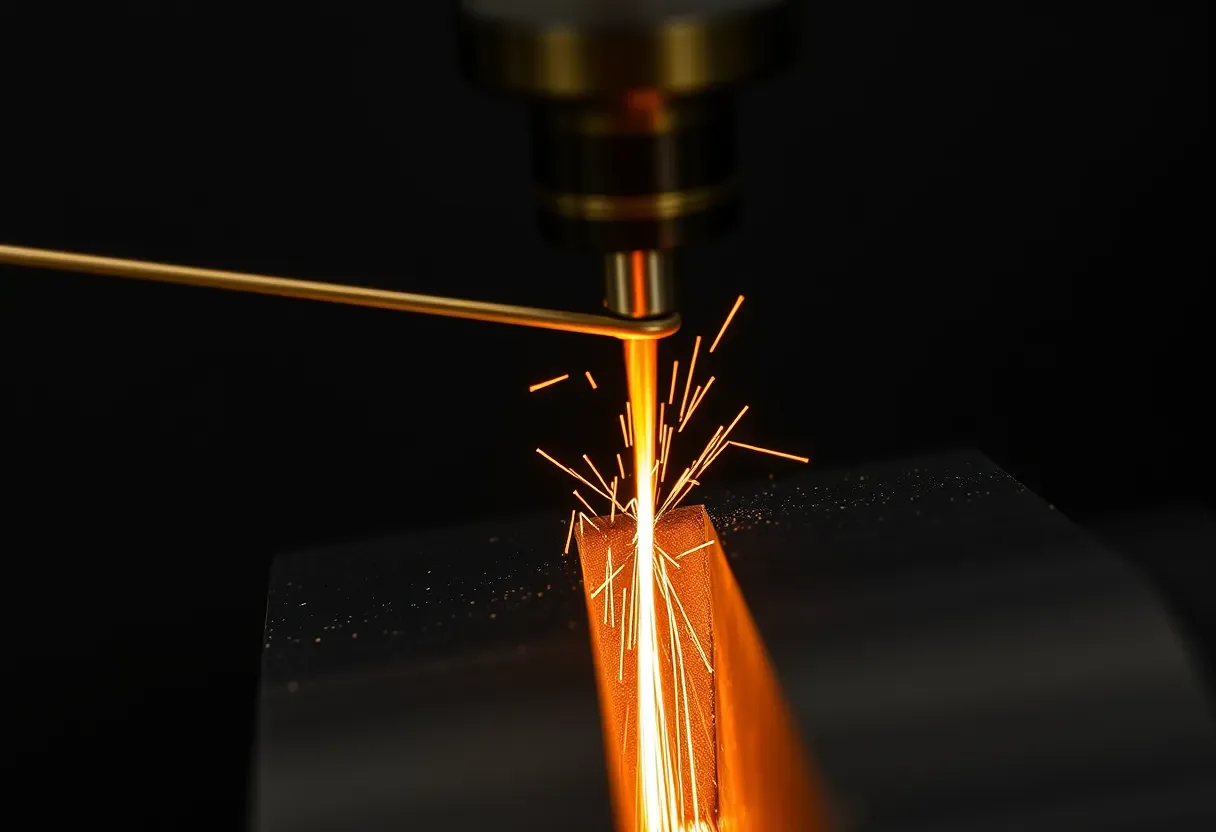
Electric discharge machining (EDM) removes metal with controlled sparks, not cutting edges. Because the spark never touches the part, hardness does not slow it down. EDM shapes hardened dies, cuts sharp internal corners, and leaves no burrs. Choose it when milling cannot reach the geometry or hardness; otherwise, mill.
Controlled sparks, not cutting edges
If you have ever typed "what is EDM machining" into a search bar, you have mostly landed on factory tours and textbook chapters. Both skip the question an engineer actually faces at the desk: does my part need this process, or is it an expensive detour?
I work with a manufacturing platform whose daily bread is CNC machining and metal 3D printing, so I will answer it the way our engineers do at the quote desk: how the process works, where wire EDM and sinker EDM split, which materials and features genuinely call for sparks, and where the line sits between an "EDM part" and a part you should simply mill.
How Does the Electrical Discharge Machining Process Work?
The name sounds exotic. The physics is a short circuit, scheduled and repeated. Every cut is a storm of microscopic sparks, and each spark removes one speck of metal.
EDM erodes metal by spark discharges between an electrode and a conductive workpiece separated by dielectric fluid. Each spark melts a microscopic crater, and the fluid flushes the debris away. Repeat many thousands of times per second, and the electrode's shape walks into the part.
A short circuit, scheduled and repeated
Strip away the cabinet and the electrical discharge machining process is a circuit with five parts. The workpiece sits in a bath of dielectric fluid — deionized water on wire machines, hydrocarbon oil on sinkers. An electrode — a traveling wire, or a shaped block of graphite or copper — is held a fraction of a millimeter away by a servo that listens to the gap. A pulse generator charges that circuit many thousands of times per second. Each time the voltage breaks the fluid down, a spark jumps, the discharge channel reaches several thousand degrees Celsius, and a microscopic crater melts out of both surfaces. The fluid then collapses the bubble, quenches the spot, and sweeps the resolidified debris spheres toward the filter. The servo restores the gap, and the cycle repeats — millions of discharges for a single cavity.
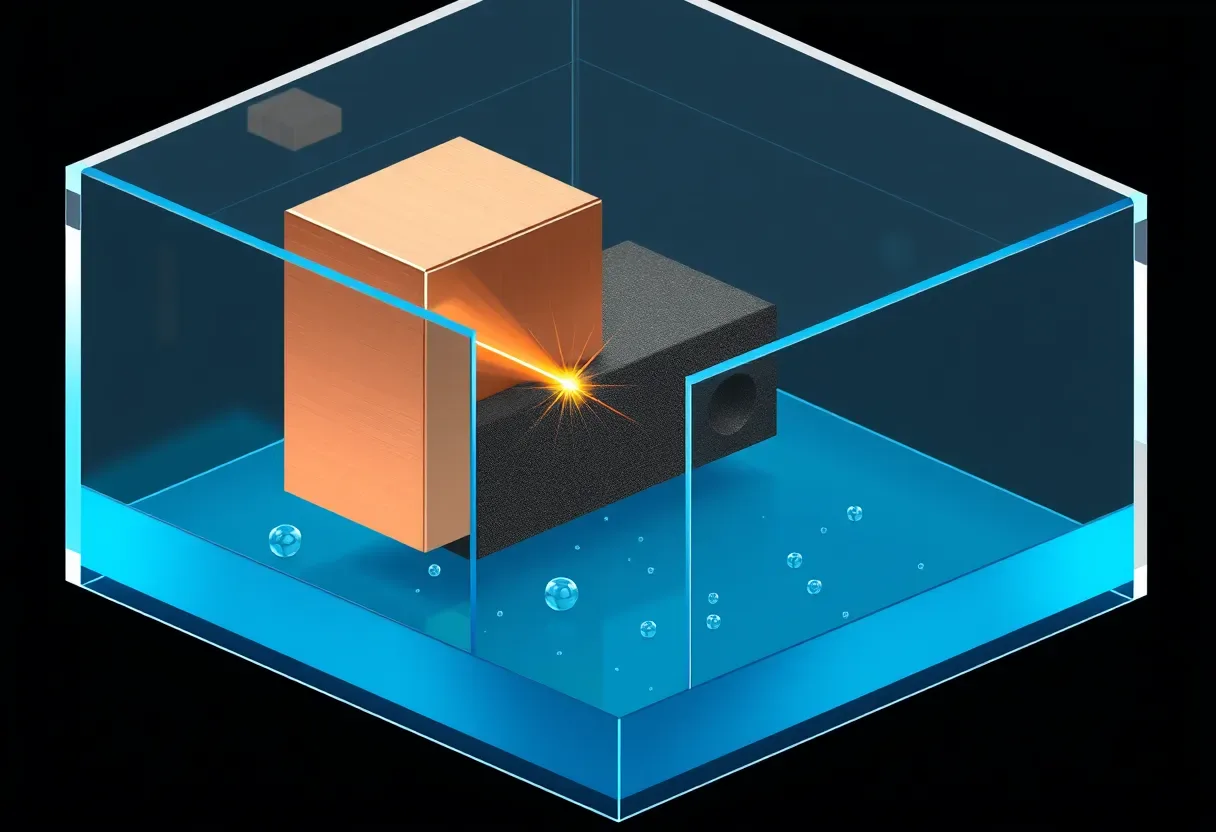
The circuit
Five parts of every EDM cut.
| Feature | Capability |
|---|---|
| Workpiece | Any electrically conductive metal; hardness is irrelevant |
| Electrode | Carries the shaped current — traveling wire (wire EDM) or formed graphite/copper block (sinker) |
| Dielectric fluid | Insulates until breakdown, cools the spot, flushes debris |
| Pulse generator | Meters energy per spark — roughing burns fast, finishing burns fine |
| Servo gap control | Holds the discharge gap and backs off when debris shorts it |
Two consequences follow from the physics, and they explain most of what people like and dislike about EDM. First, the part must conduct electricity; the circuit cannot close through a ceramic or a plastic. Second, both electrodes erode. Engineers choose electrode material, polarity, and pulse settings so the tool sacrifices slowly while the workpiece gives up shape quickly — but on sinker machines, electrode wear is a real cost you plan around, because a worn electrode no longer burns the cavity you drew.
The Encyclopaedia Britannica compresses the same loop into one sentence — high-frequency spark discharges from a graphite or soft-metal tool eroding the workpiece to shape. (Why this link: an independent encyclopedia confirming the spark-erosion principle.)
Wire EDM or Sinker EDM: Which One Does Your Part Need?
Both flavors erode with sparks. They differ in the electrode, the fluid, and above all in whether the feature goes all the way through the part.
Wire EDM cuts through-features with a traveling brass wire in deionized water: profiles, gears, tapers, fine slots. Sinker EDM burns blind shapes with a preformed graphite or copper electrode in oil: mold cavities, blind ribs. Through part, think wire. Blind pocket, think sinker.
Through part, think wire. Blind pocket, think sinker.
Wire EDM feeds a spool of brass wire — typically 0.10 to 0.30 mm in diameter — through the workpiece like a bandsaw blade that never stops moving. The wire is used once: it travels continuously, so erosion never gets time to change its diameter mid-cut, which is why the process holds size so well. Because the wire starts outside the part, every wire feature is a through-feature. Most machines tilt the wire for taper work; the smallest inside corner is limited to roughly the wire radius plus the spark gap; and accuracy or finish beyond the standard cut is bought with skim passes that retrace the profile at low energy. Small-hole EDM drilling — a rotating brass tube that burns start holes for wire threading, or deep fine channels — rounds out the family.
Sinker EDM, also called ram or plunge EDM, is the opposite bargain. A machinist cuts or casts an electrode as the mirror image of the pocket you want — graphite most often, copper when finish matters — and the machine plunges it into oil, burning the shape downward. Wear is planned, not avoided: roughing electrodes do the heavy removal, finishing electrodes size the cavity, and severe geometries may consume a full set. That electrode is real tooling with real lead time, which is the honest price of a blind cavity in hardened steel.
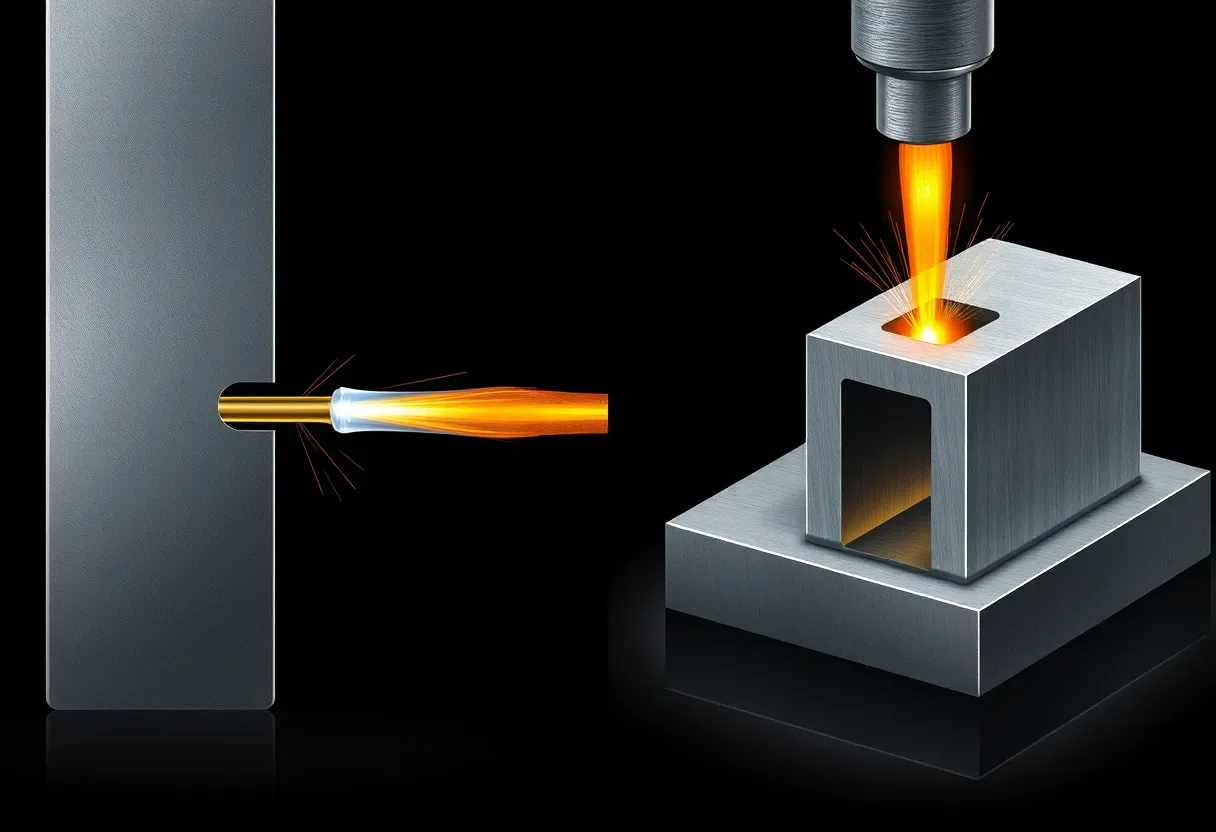
Wire vs sinker
The two EDM flavors, side by side.
| Feature | Capability |
|---|---|
| Electrode | Wire EDM — Traveling brass wire, 0.10–0.30 mm typicalSinker EDM — Formed graphite or copper electrode |
| Dielectric | Wire EDM — Deionized waterSinker EDM — Hydrocarbon oil |
| Feature type | Wire EDM — Through-profiles, slots, gears, tapersSinker EDM — Blind cavities, blind ribs, sharp blind corners |
| Inside corner limit | Wire EDM — Wire radius + spark gapSinker EDM — Electrode detail; near-zero with fine electrodes |
| Tooling cost | Wire EDM — None — no custom electrodeSinker EDM — Electrode fabrication plus wear allowance |
| Typical jobs | Wire EDM — Punch dies, extrusion dies, burr-free trimsSinker EDM — Mold cavities, blind features in hardened blocks |
Sodick, an EDM machine builder, publishes a plain-language walkthrough of how its wire machines cut. (Why this link: the machine OEM's own explanation of wire EDM practice.)
What Are the Advantages and Disadvantages of EDM Machining?
EDM trades speed for reach. It solves problems milling cannot, and it fails in ways milling never will. Both halves of that trade belong in your decision.
EDM's advantages: it cuts at any hardness, pushes zero cutting force, leaves edges burr-free, and reaches sharp internal corners and blind cavities. Its disadvantages: conductive materials only, slow removal, electrode costs, and a thin recast layer and heat-affected zone that every spark leaves behind.
Every spark leaves a signature
The advantages trace straight back to "no contact." Hardness is irrelevant because nothing mechanical touches the part: a die block hardened past 60 HRC cuts as-is, with no anneal, machine, re-harden, and grind loop built around it. Cutting force is zero, so a 0.1 mm rib, a thin-walled bellows, or a needle-thin punch does not deflect the way it would under a spinning mill. Wire-cut edges arrive burr-free — there is no tool exit to push a burr up — which quietly deletes a deburring operation from your traveler. And geometry that is simply closed to a rotating tool opens up: sharp inside corners in a through-profile, and complex blind cavities sunk deep into a hardened block.
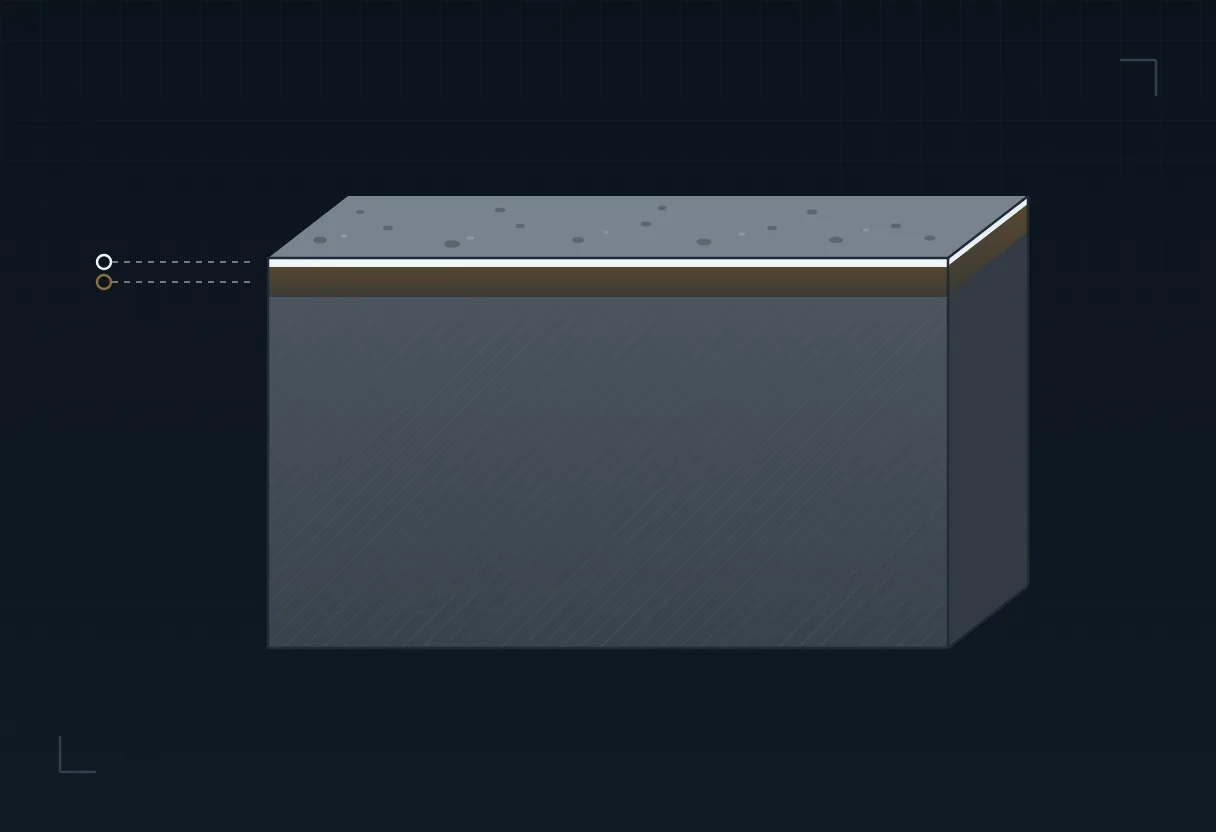
The disadvantages are just as physical. Material leaves the part one crater at a time, so removal rates sit far below a milling machine's — EDM wins on reach and loses on the clock. Only conductive metals qualify. Sinker work carries electrode fabrication and wear inside the quote. And every spark leaves a signature on the surface: a thin recast layer of melted-and-refrozen metal sitting over a heat-affected zone. On most parts nobody cares. On a fatigue-critical or sealing surface, that white layer may call for lapping or polishing to remove — budget the operation, because as-cut EDM finish is a matte topography, not a milled sheen.
The trade
What EDM solves, and what it costs.
| Feature | Capability |
|---|---|
| Hardness | Advantage — Cuts hardened steel and carbide as-is |
| Forces | Advantage — Zero cutting force; a 0.1 mm rib survives |
| Edges | Advantage — Burr-free, no deburring stepDisadvantage — Matte as-cut finish; recast layer and heat-affected zone |
| Geometry | Advantage — Sharp inside corners; blind cavitiesDisadvantage — Wire inside corners limited by wire radius |
| Economics | Advantage — No fixturing heroics for fragile partsDisadvantage — Slow removal; sinker electrode cost; conductive metals only |
Which Materials and Applications Actually Call for EDM?
Conductivity is the entry ticket; economics decide the rest. EDM earns its keep where hardness, thinness, or geometry has shut the door on a rotating tool.
Any electrically conductive metal can be EDM'd: hardened tool steels, carbide, copper alloys, nickel superalloys. Classic applications are mold and die cavities, punch and extrusion dies, wire-cut gears, and rescuing parts with broken taps. Soft, conductive metals like aluminum rarely justify EDM — milling removes them far faster.
Where every mature toolroom owns both machines
The material list is short to state: if it conducts electricity, it can spark. In practice EDM concentrates where conventional cutting struggles — hardened tool steels at full hardness, sintered carbide, copper alloys for mold details, and hot-section superalloys that chew up end mills. Note the exceptions: aluminum and pure copper conduct perfectly, yet almost never justify sparks, because a milling machine evacuates them many times faster. Conductivity qualifies a material; it does not win the argument.
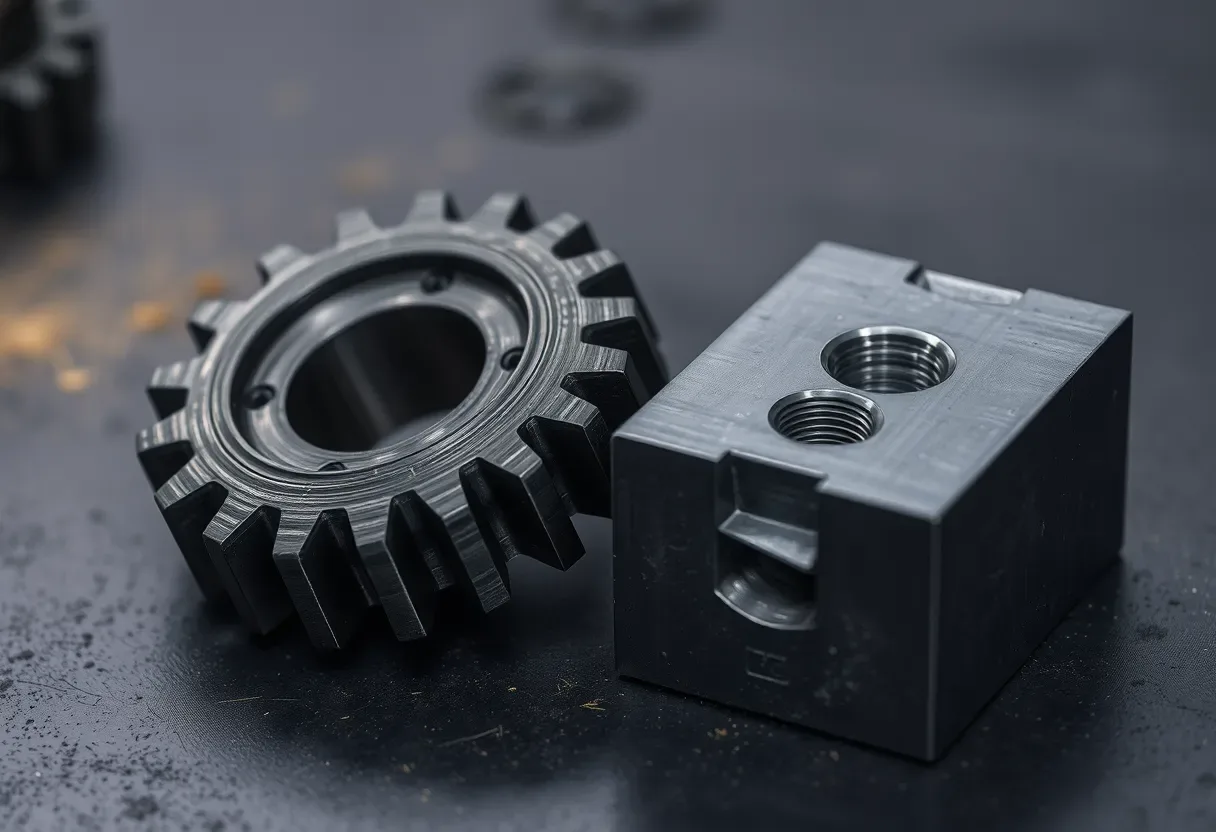
The application list explains why every mature toolroom owns both machine types. Cavity work is the flagship: the shaped pockets inside injection-mold tooling have historically been sinker EDM's home turf, cut into hardened cavity steel after heat treatment so the detail holds up under pressure. Punch and die sets, extrusion profiles, and compound trim dies get their sharpest edges from wire. Gears, splines, and burr-free trims on finished components are wire work too. And then there is the rescue job every shop knows: a snapped tap buried in an expensive part, which wire EDM can erode out of its own threads without touching them.
Where does tooling for pilot runs fit? In a conventional toolroom, EDM is how cavity steel gets its shape. At pilot scale, our route skips it entirely — the rapid injection molding service on our site cuts aluminum molds directly on machining centers, and MIM pilot tooling is machined or printed the same way. EDM enters your program when a hardened-steel tool is genuinely the right answer, not by default.
EDM vs CNC Milling: When Should You Choose Each?
Most parts never need EDM. A few cannot be made without it. Here is the decision table our engineers walk through when a drawing arrives.
Choose milling for speed, cost, bulk removal, and 3D contours — it holds ±0.05 mm routinely on our floor. Choose EDM when the material outruns cutters, the inside corner is tighter than the tool radius, or the wall is too thin to survive a cutting force. Conductivity required.
Milling is the default and should stay the default
Milling is the default and should stay the default. It removes material orders of magnitude faster, holds ±0.05 mm as a routine tolerance on our machining centers, cuts any solid — conductive or not — and sculpts the freeform 3D surfaces that wire EDM cannot trace and sinker EDM cannot mirror. Cost follows time, and time favors the mill in almost every case where the mill is physically possible.
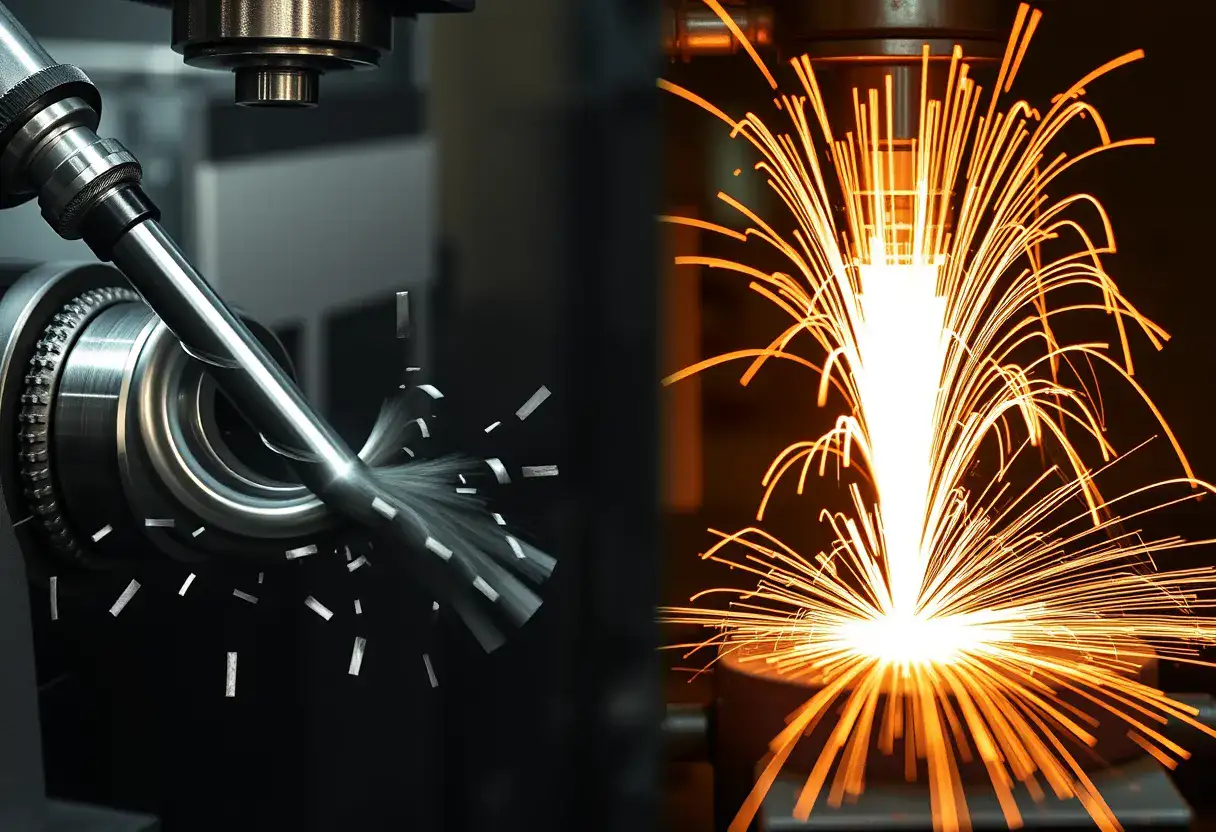
The decision table
What your drawing says, and the process that answers it.
| Feature | Capability |
|---|---|
| Hardness above roughly 50 HRC, feature reachable by wire | Wire EDM — Cutters give up; sparks do not care |
| Inside corner radius below the smallest end mill you can run | Wire EDM — Corner reaches wire radius + gap, not tool radius |
| Wall or rib thinner than about 0.3 mm | Wire EDM — Zero cutting force; nothing deflects the part |
| Blind, detailed cavity in a hardened block | Sinker EDM — The only economical route to that geometry |
| Bulk removal, deep pockets, freeform 3D surfaces | CNC milling — Faster by an order of magnitude or more |
| Fatigue-critical or sealing surface | Milling or grinding — No recast layer to remove afterward |
| Non-conductive material | CNC milling only — EDM cannot close the circuit |
And the honest disclosure for this blog. EDM is not a listed Arterki service. Wire EDM is available on our floor for select applications, including metal 3D printing build-plate removal — ask us if your project needs it. Everything else routes to what we run every day: CNC machining in three and five axes plus turn-milling, industrial resin and nylon printing, rapid aluminum-tool injection molding, and MIM pilot runs — each part shipped with its inspection report.
Conclusion
EDM is a specialist's tool: sparks instead of edges, conductivity instead of hardness limits. When your drawing hides one of those features, you now know which way to turn.
About Arterki
Arterki is an engineering-grade manufacturing platform in Beijing. We build prototypes and low-volume batches with CNC machining (±0.05 mm routine), industrial SLA and SLS, engineering FDM (PLA, ABS, ASA, PA12-CF, TPU, plus high-temperature polymers), rapid aluminum-tool injection molding, and MIM pilot runs. Every shipment includes an inspection report measured against your drawing.
What's in your inspection report: as-built dimensions checked against your drawing, the material and process actually used, and the measuring equipment behind every number.

Send us your drawing.
Get an engineering-reviewed quote within 24 hours — DFM feedback included, and an inspection report with every part that follows.
One-stop prototype & low-volume build · Inspection report with every part · Quote in 24 h