



Aluminum 7075 CNC Machining: When the Part Has to Be Strong
7075 is the aluminum you escalate to. Same machining platforms as 6061, same tolerances — roughly double the strength, at the cost of corrosion behavior and weldability. We cut it daily on 3- and 5-axis platforms, and every shipment carries a dimensional inspection report.
Quick answer: Arterki CNC machines aluminum 7075 to ±0.05 mm standard tolerance (±0.02 mm on request, metrology-confirmed) on 3- and 5-axis platforms, in prototype and low-volume quantities. Lead time confirmed at quotation, quotes within 24 hours, inspection report with every shipment.
7075 at Arterki: Machined in-house on 3- and 5-axis platforms with turn-mill. ±0.05 mm standard. Anodizing and plating via certified partners; engineer DFM review on every drawing.
What is machined 7075 used for?
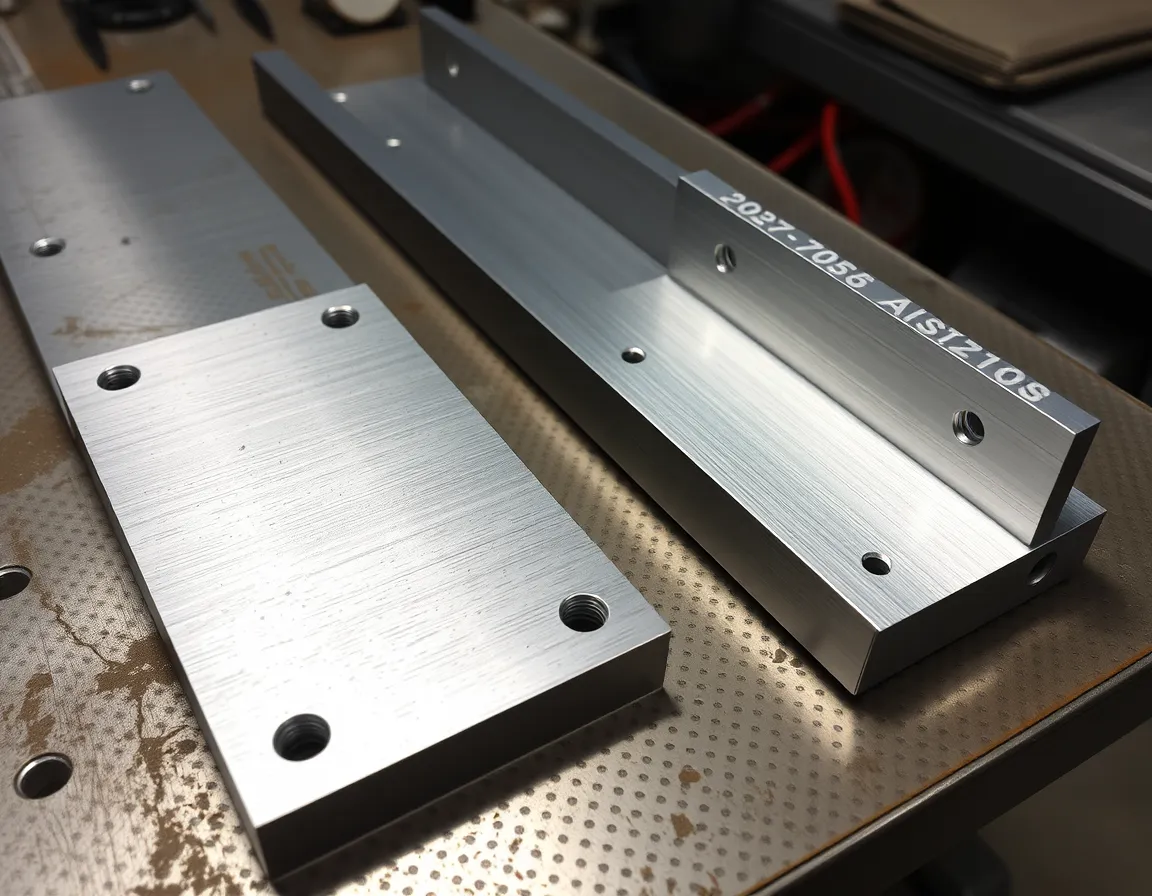
High load in low weight, repeated indefinitely. On our floor, 7075 becomes structural brackets and arms, fixture and tooling plates, high-load housings, linkage and actuation components, mold inserts, and robotics end-effectors.
The argument for 7075 over the default 6061 is simple: yield strength in the T6-T7 class roughly doubles, so a bracket shrinks or a wall thins while carrying the same load. In mechanism-dense assemblies that trades directly into moving mass — less inertia, faster cycles, smaller actuators. Its fatigue behavior under repeated load is also where teams land when a 6061 prototype passed but the duty cycle says the production part deserves margin.
The honest counterweights: 7075 carries less corrosion resistance than 6061 (it is usually anodized or coated for exposure — via certified partners on our floor), it is not a welding alloy, and its formability is lower, so bent-sheet designs belong in 6061 or 5052.
A pattern that recurs on our floor: a fixture plate for a robot cell starts life in 6061 and survives testing; then the duty cycle doubles, the plate loses a bolt hole to fatigue, and the redesign lands in 7075 with the same geometry. The machinist notices nothing — same setups, same programs, finer finish — and the test cell stops eating plates. Between that story and its mirror (a bracket that lives in dry indoor air and never loads past 6061's yield) sits the whole 7075 decision: pay for strength only where the load path demands it, and let the anodize partner handle the weather when the part goes outdoors.
How does 7075 machine on CNC platforms?
7075 machines cleanly — better surface finish than 6061 in fine cuts, with chips that break predictably:
Tooling and speeds. High-speed strategies with sharp carbide hold tolerance without heat buildup; 5-axis contours in 7075 finish to a consistent surface that showcases the alloy.
Stability. The alloy is dimensionally well-behaved; the ±0.05 mm class is routine, and ±0.02 mm features are confirmed at quotation with metrology on the report.
Residual stress. Plate and bar stock can hold stress; on long thin parts we sequence roughing and let things relax before finish passes — a habit that keeps thin walls straight after the final cut.
Turn-mill. Round features, shafts and threads cut in one setup, keeping concentricity where rotating parts need it.
Platform details live on the CNC machining page.
Design notes for 7075 parts
Fillet everything structural. 7075's strength is real but stress concentrations still rule fatigue life; generous fillets at load paths are the cheapest reliability you can draw.
Thin-wall expectations. Thin walls are reviewed case by case in the DFM feedback, with fixturing and support planned per part.
Corrosion plan. For anything exposed, specify anodize or chrome-conversion at order time — finishing runs via certified partners with lead time quoted alongside machining.
Threads and inserts. Helicoil-class inserts in loaded bores outlive cut threads in any aluminum; the DFM reply will flag bores that deserve them.
Mold use. 7075 is our standard mold-insert material for rapid tooling — the same machinability that speeds parts speeds tools.
7075 compared with structural alternatives
| Feature | Capability |
|---|---|
| Machined 7075 | Highest-strength common aluminum, great finish · Cost above 6061; needs coating outdoors; unweldable · CNC, in-house |
| Machined 6061 | Default aluminum: strong, weldable, anodizes well · Roughly half the yield strength · CNC, in-house |
| Stainless 304 | Corrosion-proof, stiffer · 3× density; slower machining · CNC + SLM printing |
| MIM small steel parts | Complex small steel parts in process-validation batches (tens to hundreds) · Tooling and batch commit · MIM line, in-house |
| Titanium-class alloys | Strength-to-weight ceiling · Cost and lead time · Program-level inquiry |
Shortcut: 6061 until the FEA says otherwise; 7075 when the FEA says so; steel when corrosion or stiffness dominates; titanium when the budget already knows.
Frequently asked questions
Can you hold ±0.02 mm on 7075? Yes, feature-level — confirmed at quotation with metrology, and those features are called out on the inspection report that ships with the parts.
Can 7075 parts be anodized? Type II and III anodizing run via certified partners, quoted with machining so finish and parts travel one schedule; note 7075 anodizes to a less uniform tone than 6061 — cosmetic colors favor 6061.
7075 or 6061 for my bracket? Send the loads or the drawing — the engineer answers with reasoning in the quote. The default is 6061; we escalate to 7075 when mass or fatigue margin pays for it.
Does 7075 weld? It is a machining alloy, and welded structures in 7075 are a specialty process — assemblies in our shop route through bolted and pinned joints, with weldable 6061 as the design alternative. A note on pairs: 7075 parts often ship alongside 6061 in the same assembly — high-load arms in the stronger alloy, plates and covers in the economical one. Send both drawings in one request and the quote prices the pair on one schedule with one inspection trail.
Machining parameters and what to expect
| Feature | Capability |
|---|---|
| Tolerance class | ±0.05 mm standard · ±0.02 mm feature-level, metrology-confirmed |
| Surface finish | Fine, consistent · Excellent 5-axis contour finish |
| Stock forms | Plate, bar · Stress-managed roughing on long parts |
| Typical lead time | Confirmed at quotation · Finishing via partners quoted alongside |
What does 7075 cost versus 6061? Stock carries a premium and machining time is comparable; on most parts the delta concentrates in material. The quote shows both alloys where the design allows, so the choice is a number.
Can you machine large fixture plates in 7075? Yes — plate work spans the 3-axis platform's envelope with stress-relief passes planned; flatness targets are confirmed at quotation and measured on the report. Can you supply material certificates with 7075 parts? Ask at quotation. Where the stock supplier provides a mill certificate, whether it can accompany your order is confirmed in the quote; the inspection report covers the dimensions you mark critical. Can you finish 7075 parts for corrosion protection? Anodize, chrome conversion and paint prep all run via certified partners, quoted on the same schedule as machining so the parts arrive finished, with the finish noted on the inspection trail.

Get a quote for machined 7075 parts
Send a STEP file or 2D drawing with quantities and the dimensions you consider critical. An engineer replies within 24 hours with DFM feedback, finishing options via certified partners, and the tolerance plan we will inspect to.
One-stop prototype & low-volume build · Inspection report with every part · Quote in 24 h